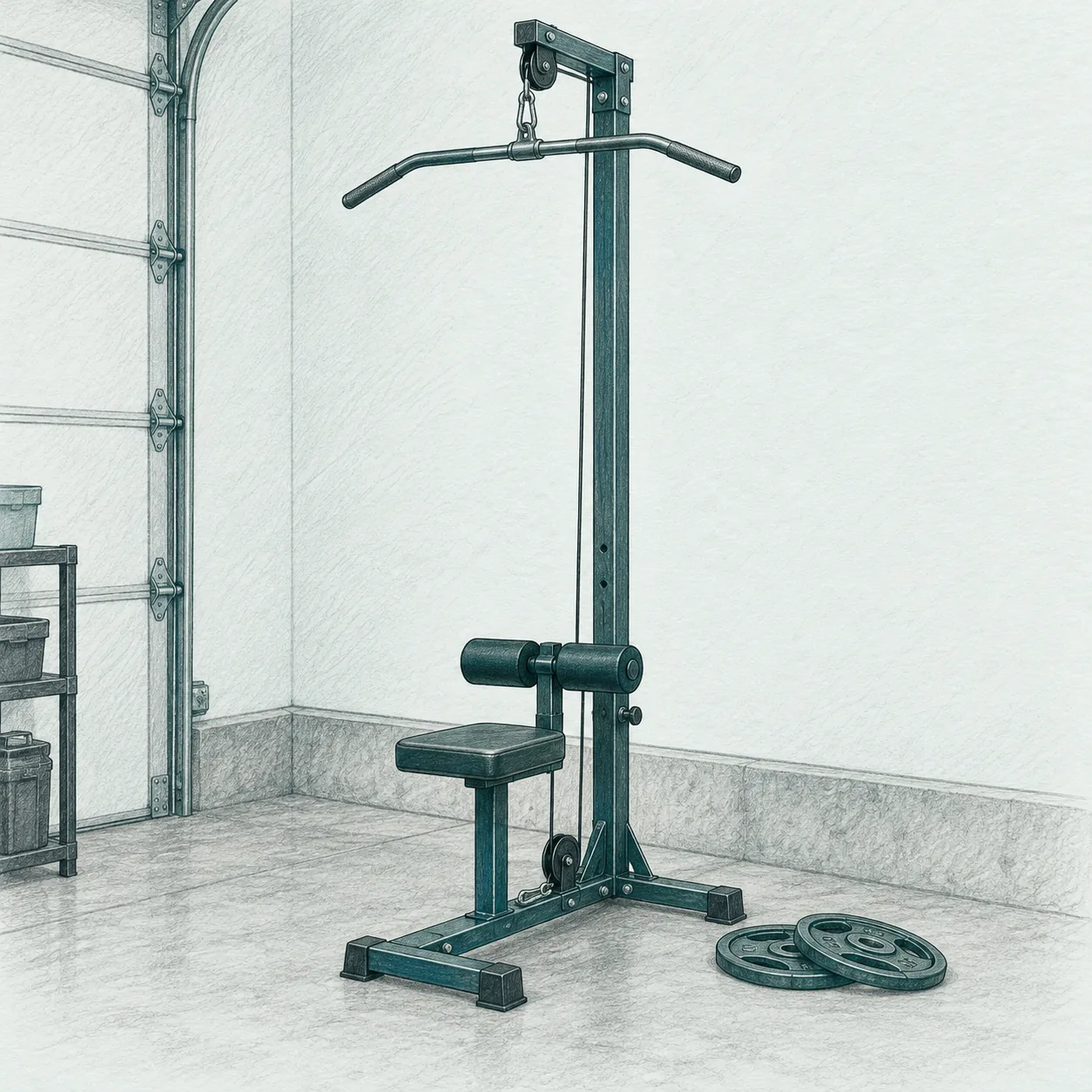
Lat Pulldown Machine for a Home Gym: Best Picks (2026)
Cable machines
The best lat pulldown machine for a home gym is the GOIMU LS01, a freestanding three-station tower that covers pulldowns, rows, and crunches for under $200. Here are the three picks worth buying.
Our picks
A home gym asks three questions a commercial floor does not: how tall the tower stands, how much floor it takes, and whether it needs a wall. The three towers below are all freestanding and plate-loaded, so none needs a mount and all three use plates you already own. Each one costs under $250.
The lat pulldown is the back exercise most home gyms are missing. A pull-up bar builds your lats with your bodyweight, but it will not let you run a light set, a slow negative, or a single-arm pull. A tower gives you that control, and most of the better home models add a low pulley so you can move straight into seated rows.
These three towers all fit a garage corner or a spare-room wall. This guide sits with our cable machine guides. If you are still building the room out, pair a tower with a weight bench and a set of adjustable dumbbells. If you would rather bolt a station to the wall instead, our cable machine guide covers that route.
What does a lat pulldown machine add to a home gym?
A lat pulldown machine trains your lats, the broad muscles that give your back its width, along with the mid-back and the biceps that help the pull. Because you sit and pull a bar down a fixed line instead of lifting your whole bodyweight, you can train the pattern even when a full pull-up is still out of reach.
Which muscles does a lat pulldown work?
The lats and the teres major do most of the work, with help from the biceps, the rear delts, and the mid-back between your shoulder blades. A wide overhand grip leans on the lats for width. A close underhand grip brings in more biceps and lower lats.
That range is what makes a tower useful at home. Free weights alone would need a heavy dumbbell row to feel anything similar, and a row does not load the lats from overhead the way a pulldown does. The cable machine guide covers the wall-mounted version of the same pull if your wall is the better home for it.
Which lat pulldown machine fits under an 8 ft ceiling?
An 8 ft ceiling is 96 in, so the tallest pick here leaves about 12.5 in of headroom and the shortest leaves about 22 in. Measure to the lowest joist, pipe, or garage door track, not to the ceiling itself, because that gap is what decides whether a tower stands in the room.
How much floor space does a home lat tower take?
A home lat tower takes about 10 to 13 square feet of floor and stands 73 to 84 inches tall, depending on the model. The footprint is bigger than the tall, thin frame suggests, because the base and your standing room both count. Here are the home-gym numbers for the three picks, taken from the makers.
For context, a typical lat pulldown machine runs about $1,640.74 and stands 87.2 in tall, so these three towers cost 12 to 13 percent of that and run lower to the ceiling. That is the whole reason a compact tower works in a garage where a full machine would not.
The height split decides the room. The LS01 stands 83.46 in and the YOLEO 73.3 in, so in a basement with joists at 84 in the YOLEO is the safe call and the LS01 is not. Measure to the lowest pipe or joist over the spot you plan to use, not to the ceiling itself.
Which lat pulldown machine is best for most home gyms?
The GOIMU LS01 is the best pick for most home gyms, because one freestanding tower covers a high pulley for pulldowns, a low pulley for rows, and an ab crunch station, and it does it for $199.49 right now, about 26 percent off list. At 4.4 stars over 102 ratings, it is the pick we would hand a lifter who wants one machine and a full back session.
Why it is our top home-gym pick:
- Three stations on one frame cover lat pulldowns, seated rows, and cable crunches.
- A 730 lb frame rating and 2 mm steel take heavy pulldowns without a flex.
- The padded seat adjusts to three heights, so shorter and taller lifters share it.
- The detachable sleeve fits 1 in and 2 in plates, so you use plates you already own.
The honest limit is height. At 83.46 in the LS01 is the tallest of the three, and it stands about 12.5 in under an 8 ft ceiling, so measure your joists and any garage door track before you order.
Which lat pulldown machine is best for a tight home floor?
The Mikolo G2 is the pick when floor space is the whole problem. It is the lightest tower here at 71 lb, it lists a 10 sq ft footprint, and it still gives you the high and low pulley pair for pulldowns and rows. It sits at 4.6 stars over 110 ratings.
Why it is our compact pick:
- At 71 lb it is light enough for one person to move and reposition.
- A 10 sq ft footprint tucks into the corner of a small room.
- The detachable sleeve takes 1 in and 2 in plates without adapters.
- A 13 by 18 in seat with three heights and a leg hold-down suits a shared gym.
Two things to know. The 450 lb rating and the 800 lb cable are lower than the top pick, which is fine for most home pulling but not for a heavy low row. And the tower is freestanding, so on a rough slab you may shim a foot the same way you would with any tower.
Which lat pulldown machine is best for a low ceiling?
The YOLEO 2-in-1 is the pick for a short basement, because at 73.3 in it is the lowest tower here and it still presses a full back session. The seat slides for cardio rowing and locks for strength work, and the frame carries a 450 lb rating. It sits at 4.8 stars over 37 ratings, the highest average of the three.
Why it is our low-ceiling pick:
- At 73.3 in it is the lowest pick, which suits a short basement.
- A sliding seat and a 49.6 in rail add a full rowing movement to the same tower.
- 13 upright settings and 9 seat positions dial in the pull angle.
- A 10,000 bend-tested cable and seven ball-bearing pulleys keep the pull smooth.
The trade is length. The rowing rail makes the YOLEO the longest tower here, so it wants a clear run of wall rather than a tight corner. It also has the fewest ratings of the three, so weigh that against the higher average.
How do the three home lat towers compare?
All three are freestanding and plate-loaded, so they split on price, footprint, and the plates they take. Here is how they compare on cost per pulley station and the plates each one loads.
Which lat tower costs least per pulley station?
The GOIMU is the best value per station at $66.50, because it throws in the ab crunch station on the same frame. The Mikolo and the YOLEO each pair a high and a low pulley, so they work out near $100 per pull station. If you count the YOLEO's rowing seat as a station, it drops closer to $70.
Is a 2:1 pulley ratio better than 1:1?
Neither is better in general. A 2:1 ratio halves the load at the handle and doubles the cable travel, so 100 lb of plates feels like 50 lb with a longer, smoother pull. A 1:1 ratio gives you the full load, which heavier pullers prefer. Beginners often like 2:1 for the finer weight steps.
Check the ratio before you buy if you train heavy lat pulldowns, because a 450 lb plate rating at 2:1 is only 225 lb at the bar. If the maker does not list a ratio, treat it as 1:1.
Plate-loaded or selectorized: which fits a home gym?
For most home gyms, plate-loaded wins, because you already own the plates and the tower costs a fraction of a stack machine. A selectorized stack changes weight with a single pin, which is faster, but it costs well over $1,000 and brings a heavy frame into the room.
All three picks here are plate-loaded, so you load them with your own plates each set. The trade is loading time for a lower price and a quieter room, since there is no stack to clank. If you already own Olympic plates, that is money you do not have to spend.
Do you need a lat pulldown machine if you have a pull-up bar?
Not if you can already do a full set of strict pull-ups and you are happy with bodyweight. Add a tower when you want to load the lats below bodyweight, run slow negatives, or train single-arm pulls without the swing a bar gives you.
A bar and a tower cover different jobs. The bar builds the skill and the top-end strength. The tower adds volume, control, and a lighter starting point for a beginner still working toward a first pull-up. Many home gyms end up with both, and a doorway pull-up bar plus a tower is a complete back setup for a few hundred dollars.
How do you set up a lat tower in a home gym without wrecking the floor?
A plate-loaded tower is simple to place, but a little planning keeps it from becoming a movable, rattling machine later.
- Tape the footprint first. Mark the base and your standing room on the floor before assembly, because the base is wider than the upright looks.
- Check the ceiling over the top pulley. The bar and your hands travel above the seat, so leave clearance for both.
- Put a mat underneath. A rubber tile under the base protects concrete and catches the plates you set down between sets. It also cuts the noise on a hard floor.
- Shim a rock before you load it. A freestanding tower can rock on a rough slab, and a thin rubber shim under one foot is a two-minute fix.
- Re-torque the frame bolts after week one. A tower takes repeated shock at the top pulley, so check the bolts once you have a few sessions on it.
What weight should you start with on a lat pulldown?
Start light, around 25 to 40 percent of your bodyweight, and add a plate only when you can pull it for a clean set of 10 without leaning back or swinging. The first goal is a slow, controlled rep, not a big number on the sleeve.
That is also why a plate-loaded tower suits a beginner. You can load a single 10 lb plate and still train the movement, and on a 2:1 pulley that 10 lb feels like 5 lb at the bar, so you have fine steps to work with.
Who should skip a lat pulldown machine
A tower is a strong second piece of gear and a poor first one. Skip it if any of these sound like you.
- You do not own free weights yet. Build the base first, a bar or a set of dumbbells. A tower is a complement, not a starting point.
- You have one clear wall and no floor corner. A wall-mounted station takes less floor than a freestanding tower, so the cable machine guide is the better fit.
- You want a full cable crossover. If your goal is chest flys and a wide machine, a functional trainer covers more movements, at a higher price and a bigger footprint.
- A pull-up bar already covers your back day. If strict pull-ups are easy and you do not need lighter loading, a bar is enough.
Bottom line
If you want one machine that adds a full back session to a home gym, get the GOIMU LS01. If your floor is tight and you want the lightest tower, get the Mikolo G2. If you want a lat pulldown and a rower in one frame and a low ceiling, get the YOLEO 2-in-1.
Any of the three adds more usable back work than a second set of dumbbells, and all three fit under $250 and a garage corner.
Frequently Asked Questions
What is the best lat pulldown machine for a home gym?
The GOIMU LS01 is the best pick for most home gyms, because one freestanding tower covers lat pulldowns, seated rows, and ab crunches for under $200 and needs no wall mount. If floor space is tight, the lighter Mikolo G2 fits a smaller corner. For a low ceiling, the YOLEO 2-in-1 is the one to buy.
How much ceiling height does a lat pulldown machine need?
Plan for the tallest pick plus a little clearance. The GOIMU LS01 stands 83.46 in, the YOLEO 73.3 in, and an 8 ft ceiling is 96 in, so the shortest pick leaves about 22 in of headroom while the tallest leaves about 12.5 in. Measure to the lowest joist, pipe, or garage door track.
How much floor space does a home lat tower take?
Plan on about 10 to 13 square feet of floor plus standing room, and 73 to 84 inches of height. The base is wider than the thin upright suggests, so tape the footprint on the floor before assembly. A freestanding tower needs a corner or a run of wall, while a wall-mounted station takes less floor.
Do you need a lat pulldown machine if you have a pull-up bar?
Not if strict pull-ups are already easy and you are happy training with bodyweight. Add a tower when you want to load below bodyweight, run slow negatives, or pull single-arm without swinging. A doorway bar plus a tower covers both top-end strength and volume for under $300.
What pulley ratio should a home lat pulldown use?
A 2:1 ratio halves the load at the handle and doubles the cable travel, which suits beginners and smooth reps. A 1:1 ratio gives the full load, which heavy pullers prefer. If a maker does not list a ratio, assume 1:1 and check the plate rating against your heaviest pull.
Can one person assemble a freestanding lat tower?
Usually yes, and it takes about an hour to two. The frame goes together solo on most $200 towers, but the top pulley bracket is easier with a second pair of hands to hold it square. Use the maker's diagram, keep the bolts loose until the frame is square, then tighten from the base up.
Is a lat pulldown machine good for your back?
Yes for the muscles, with one caveat. It builds the lats, rear delts, and mid-back, and it is easier on the shoulders than a heavy row for many lifters. Keep your lower back still and stop the set if you feel it in your spine rather than your lats. If you have a back injury, get clearance from a clinician first.