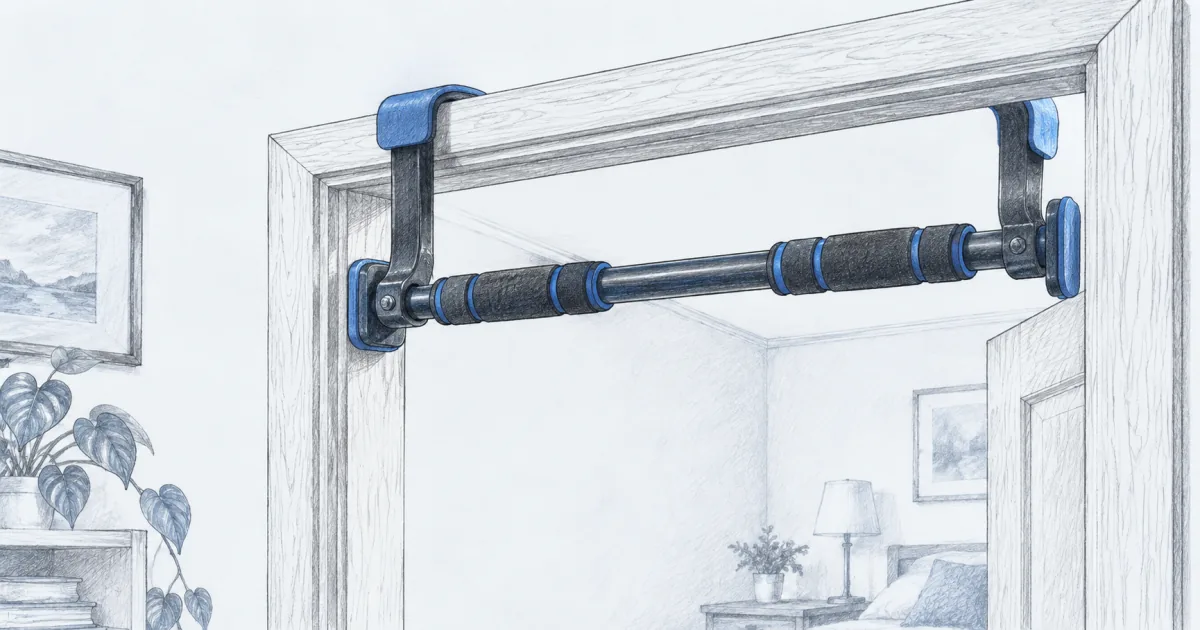
Best Pull Up Bar for Doorway (2026): Two Bars That Stay Put
Racks and benches
The best pull up bar for a doorway is the Ally Peaks leverage bar, because it fits 24 to 32 inch frames, hangs without screws, and its silicone pads left no marks in our testing. Here are the two bars worth buying, and how to measure your door first.
Our picks
The best pull up bar for a doorway is the one that actually seats on your frame. The Ally Peaks Leverage Bar fits openings from 24 to 32 inches wide, installs in under a minute, and its double silicone pads protect the trim without screws or brackets. Measure your doorway before you order, because fit is the only thing these bars really fail at.
A doorway bar is the cheapest way to add a real upper-body movement to a small space. No floor footprint, no drilling, and nothing to move when you are done. In a garage gym it is the counterpart to a squat rack that already has a pull-up bar built in, and the better choice if your ceiling is low.
This guide sits in our racks and benches guides, alongside the best squat rack for home gym. If you want dip work as well, our dip bar guide covers the free-standing option.
What a doorway bar has to clear
Three numbers decide whether a bar works, and none of them is the brand.
- Opening width. Hook-over bars fit roughly 24 to 32 inches between the jambs. Below 24 inches, almost nothing seats properly.
- Frame depth. The bar needs 4.7 to 8 inches of depth front to back to hook over the header and brace against the far side.
- Trim height and thickness. The hook has to sit on top of the trim. Very tall trim, or trim thinner than about half an inch, is where seating gets unreliable.
Measure all three with a tape before ordering. Fit problems cause more returns on these bars than weight limits do, and a bar that fits properly will hold far more than most people can pull.
Hook-over or pressure-fit: which mount to buy
There are two ways a doorway bar can hold, and they behave differently.
Hook-over with leverage. The bar hooks over the top of the frame on one side and braces against the frame on the other. Your bodyweight pulls the hook tighter. Nothing touches the walls, nothing gets drilled, and you can lift the bar off in seconds. This is the design to buy for a rental or a shared apartment.
Telescopic pressure-fit. A spring-loaded bar that pushes outward against the jambs. It stays up when the door closes, which is convenient, but it holds by friction and it loads the frame sideways. Cheaper versions also have a lower usable rating once they are fully extended.
Pick hook-over unless you specifically need the door to close around the bar. It is the more secure of the two and it is kinder to the frame.
The two doorway bars worth buying
Ally Peaks Leverage Bar: best overall
This is the bar we would hand to a first-time buyer. It hangs on leverage, so there is nothing to drill and nothing to patch later, and the silicone pads mean you can put it on a doorway you do not own.
Why we picked it:
- No screws, so it comes down in seconds when you need the doorway back.
- Double silicone pads plus a spare set protect the trim.
- Three grip positions cover wide, narrow, and neutral pull-ups.
- It doubles as a floor bar for push-ups and dips between the handles.
The honest limit is the hardware around the steel. The foam grips are the wear item on this bar, and foam compresses or rotates after months of use. The bar also flexes a little under fast kipping reps, so keep your pull-ups and hanging raises strict and it stays rock solid.
KAKICLAY Multi-Grip Bar: best for narrow frames and tall lifters
The KAKICLAY is the pick when the cheap bar will not fit. Hook spacing is cut to 21.65 inches, which opens up narrow and corner doorways, and the raised bar keeps tall lifters from folding their legs every rep.
Why we picked it for narrow doorways:
- Narrower hooks seat on doorways most hook-over bars cannot use.
- The bar sits higher, so taller lifters get a full range of motion.
- Silicone door protectors come fitted, which older versions of this bar lacked.
- It folds flat for storage and ships with suspension straps.
The honest limit is the multi-grip loop. Its opening faces you, so your hands cannot come close together for a narrow pull-up or a close-grip chin-up. If close-grip work is your main lift, take the simpler bar and keep the wider grips.
Will a doorway bar mark your frame?
Sometimes, and the cause is almost always the pad rather than the bar.
Silicone pads are the safer choice. They grip the paint without abrading it, and they do not harden the way cheap foam does over a winter in a garage. Foam pads, especially thin ones, compress and then let the steel contact the trim, which is where the marks and the chipped paint come from.
Two habits keep a frame clean. Check the pads for flat spots every few weeks and swap them when they are glossy, and take the bar down between sessions so the same contact points are not loaded all day. If you rent, keep the spare pads the bar ships with in a drawer.
Grips, height, and what to train
A doorway bar gives you three useful hand positions, and they are not interchangeable.
- Wide overhand pull-up. The most lat-dominant option, and the one most people load first.
- Neutral grip. Easier on the shoulders. The best choice if overhead work irritates yours.
- Underhand chin-up. More biceps, and usually the easiest position for beginners.
Height is the other half of the setup. A bar sits at the top of the frame, so your range of motion ends where your feet reach the floor. If your doorway is short, keep your knees tucked at the bottom and treat it as a partial range, or step up to a free-standing bar. Hanging knee raises, scapular pulls, and dead hangs all work well on the bar and need no clearance at all.
Which grip should you train first?
Start with the widest overhand grip you can hold, then rotate in neutral and underhand work. Wide overhand loads the lats hardest and is the default for most programs. Neutral is the friendliest to sore shoulders, and underhand is the easiest position for a beginner to finish a clean rep.
How many grip positions do you actually get?
Three positions cover wide, neutral, and close, and that is what most doorways allow. The Ally Peaks gives three, and the KAKICLAY is a multi-grip bar. You rarely need more, because a doorway that is wide enough to hang straight does not have room for a fourth useful spacing.
Which doorway bar fits your door?
Measure three numbers and the choice makes itself. A bar fails only when the opening is too wide or too narrow, the frame is too shallow for the hook, or the trim is too tall to seat on. Measure all three before you order.
What if the opening is under 24 inches?
Below 24 inches almost no hook-over bar seats properly, so the KAKICLAY at 21.65 inches is one of the few that will. If your opening is narrower than that, the frame is a better place for a wall mount than a bar, and a pressure-fit bar will not save you.
Does the weight limit actually matter?
Rarely, because a properly seated leverage bar holds far more than most people can pull, and the best picks publish limits around 440 lb. What matters more is that the bar seats flat and the pads stay in good shape. A 440 lb rating means nothing if the hook is perched on a thin, loose trim.
How much bar does your money buy?
Both bars carry the same 440 lb, so the $28 bar costs about 6.4 cents a pound of rating and the $70 bar about 15.9 cents. The extra $42 buys a wider fit band, 21.65 to 36.22 inches against 24 to 32, and a higher bar for tall lifters.
Who should skip a doorway bar
- You want to kip or do muscle-ups. A doorway bar is not built for that direction of load. Buy a wall-mounted or free-standing bar instead.
- Your trim is thin, loose, or unusually tall. The hook needs something solid to sit on. A pressure-fit bar or a floor station is safer.
- You have a very narrow doorway under about 22 inches. Only a small group of bars fit, and the hook spacing has to be designed for it.
- You need dips in your program. Buy a dip station. The bars that accept a doorway dip attachment give you a short, awkward range for the money.
- You want heavy weighted pull-ups. A doorway bar handles added weight fine within its rating, but a rack with an integrated bar is the more stable option once the load gets serious.
If you are building out the room, pair this with our dip bar guide for pressing and triceps work, and our weight bench guide for the bench side of the program.
Bottom line
For most doorways, get the Ally Peaks Leverage Bar. It fits the standard 24 to 32 inch openings, hangs without screws, and the silicone pads are the reason we would put it on a rented frame. It is also about $28, which makes it the easiest equipment decision in a home gym.
If your doorway is narrow, in a corner, or you are tall enough that a standard bar crowds your legs, get the KAKICLAY Multi-Grip Bar. It costs more, and it seats where the cheap bars will not. Measure your opening width, frame depth, and trim height first, then buy the bar that matches your three numbers.
Frequently Asked Questions
What is the safest pull up bar for a doorway?
A hook-over bar with wide silicone contact pads and a published weight limit is the safest bet. It carries load through the top of the frame rather than pressing sideways on the trim, and the pads keep the wood from wearing. Check that your frame depth falls inside the range the bar lists before you buy.
Are doorway pull up bars any good?
Yes, if the frame fits and you train with control. A leverage bar on a solid frame handles strict pull-ups, chin-ups, hanging knee raises, and weighted work. They are not the tool for kipping or muscle-ups, because that motion loads the frame in a direction it was not designed to take.
Are pull up bars safe for a doorframe?
The frame is usually stronger than the pads that protect it. The real risks are a loose frame, a shallow trim that the hooks cannot grip, and worn foam pads that let metal touch wood. Measure the depth and check the pads each time you hang the bar.
Is my doorway strong enough for a pull up bar?
Stand in the doorway and push up on the header with both hands. If the trim and the wall above it do not move, and the frame is at least 4.7 inches deep, a standard doorway bar will hold. Skip it if the trim is loose, cracked, or thin, and look at a free-standing station instead.
What size doorway do I need for a pull up bar?
Most hook-over bars fit openings 24 to 32 inches wide and about 4.7 to 8 inches deep, with trim up to roughly 3.5 inches tall. Measure the opening between the jambs, the frame depth front to back, and the height of the top trim. Those three numbers decide whether a bar seats properly.
Do doorway pull up bars damage the paint?
They can if the pads are foam rather than silicone, or if you leave the bar in place for months without checking it. Silicone pads with a spare set in the box are the safer choice. Take the bar down between sessions and the contact points stay clean.
Can you do dips on a doorway pull up bar?
Only with a bar that takes a dip attachment, and even then the range is short. For real dip work, a free-standing dip station is the better buy, and it can sit under the same doorway without touching the frame.