Leg Press Machine for Small Spaces: Best Picks (2026)
Racks and benches
The best leg press machine for small spaces is the PASYOU bench-and-leg-press, a 57 lb unit that packs a 12-level press and a nine-angle bench into about 10 square feet. Here are the three picks that fit a real room.
Our picks
A full commercial leg press will not fit a garage, and most home sleds take a whole bay. The three picks below are built for rooms that are short on floor: a compact bench that folds a press and a bench into about 10 square feet, a 45-degree sled that rolls aside, and a full-size combo for a dedicated corner.
The leg press is how a home lifter trains quads, glutes, and hamstrings hard without loading the spine the way a heavy squat does. The question in a small room is not whether it works, but how much floor each machine gives up and how easily it moves when the room has to do something else.
This guide sits with our rack and bench guides. Pair a leg press with a squat rack for the barbell side of leg day and a set of bumper plates for the carriage. If you are weighing a machine that shares a rack instead, our Smith machine guide covers that route.
What does a leg press machine do for your legs?
A leg press machine trains your quads, glutes, hamstrings, and calves by pushing a loaded platform away along a fixed path. Because your back stays braced against the seat, you can load the legs heavily while your spine carries far less than it would under a barbell squat.
Which muscles does the leg press work?
The quads do the most work, with the glutes and hamstrings helping at the bottom and the calves adding a push at the end. Foot position shifts the load. A high, wide stance leans on the glutes and hamstrings, while a low, narrow stance leans on the quads. A slow, full range builds more than a short, bouncy one.
That fixed path is the point. A squat makes you balance the bar, and a leg press takes the balance out so you can push the legs closer to failure safely. For a home gym, that makes a sled a good partner to a rack rather than a replacement for it.
Which leg press machine fits a small room?
The compact PASYOU is the smallest here at about 10.3 square feet, and the two 45-degree sleds take about 24.6 to 27.4 square feet. If your room has one corner and no bay, the compact press is the only one that fits, and a sled wants a straight run of floor instead.
How much room does a home leg press machine take?
A 45-degree sled takes about 24 to 27 square feet, and a compact bench-and-press takes about 10 square feet. The 45-degree machines need a straight run of floor rather than a corner, while the compact bench fits a single corner. Here are the numbers for the picks, taken from the makers.
Two numbers stand out. The compact PASYOU uses about 10.3 square feet against roughly 27 for the GMWD, which is the difference between a corner and a whole bay. And the upright RitFit stands 75.6 in tall, about 19 in taller than a 56 to 58 in 45-degree sled, so it wants a full-height wall.
What ceiling height do you need for a leg press?
A 45-degree sled needs about 56 to 58 inches of ceiling, so almost any room works. The upright sleds are the tall ones: the RitFit stands 75.6 in, so it wants a normal-height ceiling plus clearance for loading plates up top.
If your room is a low basement, the 45-degree machines are the safe choice, because you press along the floor rather than standing up into the joists. Measure to the lowest pipe or joist over the spot you plan to use, not to the ceiling itself.
Which leg press machine is best for a small space?
The PASYOU is the pick for a small room or a lifter who wants a bench and a leg press in one. It packs a 12-level hydraulic leg press, a 1300 lb-rated frame, and a nine-angle weight bench into about 10 square feet. It sits at 4.1 stars over 2,881 ratings, the most ratings of the three.
Why it is our small-space pick:
- About 10 sq ft of floor, the smallest footprint in this guide.
- At 57 lb it moves and stores easily between sessions.
- 12 hydraulic levels give a smooth concentric press with no rebound.
- Nine backrest angles make it a flat, incline, or upright bench too.
The trade is the resistance. Hydraulics give a steady concentric push but a lighter ceiling than plates, so a heavy low-rep grinder will outgrow it. It also fits users from 59 to 79 inches tall, so very tall lifters should check the fit.
Which 45-degree leg press is best for a compact garage?
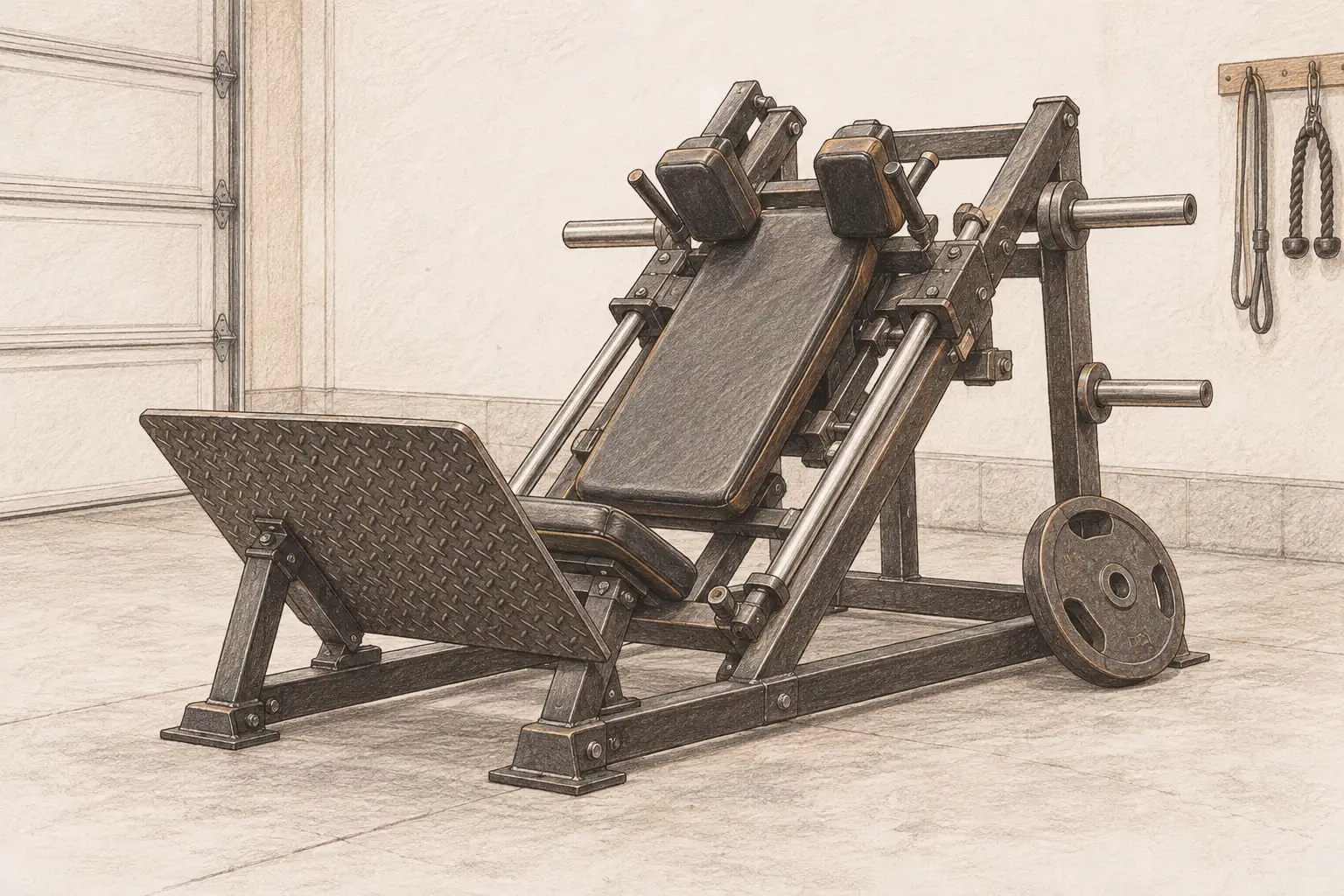
The Dripex 2-in-1 is the plate-loaded pick for a compact garage. It presses and hack squats on the same 45-degree frame, carries a 1200 lb carriage, and costs $539.97. The transport wheels are what make it a small-space machine: one person can roll it to the wall between sessions. It sits at 4.6 stars over 37 ratings.
Why it is our compact 45-degree pick:
- Transport wheels let one person move it to the wall.
- A 1200 lb carriage capacity covers a home lifter with room to spare.
- Four plate holders store plates and steady the frame at once.
- Four safety lock positions a side plus a limit stop protect a solo press.
Two things to know. The carriage needs your own 2 in plates, so budget for plates if you do not own them yet. And at 103.6 lb it is lighter than the GMWD, so on a rough slab the frame can shift a little until the plate holders are loaded.
Which leg press machine is best if you have the floor?
The GMWD combo is the pick when the room can spare the bay. It is a 45-degree combo, so it presses and hack squats on one frame, and the 385 lb unit weight is the stability you feel on every heavy set. At $699.98 right now, about 16 percent off list, it is a good week to buy. It sits at 4.5 stars over 407 ratings, the most owner reviews of the three picks.
Why it is our full-size pick:
- A 385 lb unit weight keeps the sled planted under a heavy press.
- The linear bearing system runs smoother than cheaper ball-bearing sleds.
- Three lockout positions and a 5-level safety limiter protect a solo lifter.
- Thick leather shoulder and back pads hold up to repeated hard sets.
The honest limit is size. At 84 by 47 inches it is the widest machine here, and it needs a clear run of floor plus room to load plates on both sides. Wedged into a tight corner, it will feel cramped, so buy it only when the floor is already there.
How do the small-space leg press machines compare?
The compact press and the two sleds split on capacity and cost. Here is how they compare on cost per pound of capacity.
Which leg press gives the most capacity per dollar?
The PASYOU is the cheapest per pound of rating, but its rating is a frame number, not a plate load, so the low-rep grinder should read it as a compact, higher-rep machine. Between the two sleds, the Dripex gives the same 1200 lb carriage as the RitFit for about $260 less.
Is a plate-loaded or selectorized leg press better for a small room?
Plate-loaded suits most small rooms, because you already own the plates and a sled costs far less than a stack machine. A selectorized press changes weight with a single pin, which is faster, but it costs well over $1,000 and brings a heavier frame indoors.
All three picks here are plate-loaded or hydraulic, so you set the resistance yourself. The trade is loading time for a lower price and a quieter room, since a sled has no stack to clank. If you already own 2 in plates, you are ready to load it.
Leg press or hack squat: what is the difference?
A leg press drives the platform away from you while you lie back, and a hack squat loads your shoulders and drives you up and down a fixed angle much like a machine squat. The 45-degree combo units here can do both, which is why small home gyms buy them instead of two machines.
The hack squat leans more on the quads and puts a little more load through the back of the shoulders, so it feels closer to a squat. The leg press lets you push heavier with a supported spine. Buy a 2-in-1 if you want both patterns without two footprints.
Can you switch between leg press and hack squat on one machine?
Yes, on a 2-in-1 sled you flip the back pad and lower the footplate, usually in seconds. The GMWD and the Dripex both switch this way. Check that the hack squat side lets you reach a deep, controlled position rather than bottoming out early.
That depth is the thing to check on any combo. Some budget sleds press well but run shallow on the hack squat, which is the most common complaint on combination machines. If deep hack squats matter to you, try the machine or read the reviews for that specific point before you buy.
Leg press vs squats: do you need the machine if you already squat?
No, not if your squat already covers your leg training and your back is happy with it. Add a leg press when you want to push the legs closer to failure without balancing a bar, or when a back issue makes a heavy squat uncomfortable.
The two cover different jobs. A squat trains the whole body standing and builds balance along with the legs. A leg press isolates the legs with a supported back and lets you add volume with less spinal load. For most home lifters, the smart setup is both: squat with the bar and press for extra quad and glute work.
How much weight should a beginner start with on a leg press?
Start with the empty carriage or your bodyweight on the platform, then work up in small steps. A common first working set is 50 to 100 lb for 10 to 12 controlled reps, or around a third of your bodyweight, and you add a plate only when you can control the full range.
Technique matters more than the number at first. Set the seat so your knees reach about 90 degrees without your lower back rolling off the pad, keep the platform off your knees at the top, and lower under control rather than letting the sled drop. On a hydraulic press, use the lowest level and add resistance only when the rep stays smooth.
Who should skip a leg press machine
A leg press is a strong addition and a poor first purchase. Skip it if any of these sound like you.
- You do not own a rack, a bar, or plates yet. Build the free-weight base first with a squat rack and a bar. A sled is a complement, not a starting point.
- You have no floor to give. A 45-degree sled wants 24 to 27 square feet and a straight run of floor. If you cannot spare that, the compact PASYOU at about 10 square feet is the only one that fits.
- You want a full selectorized press. If you need fast weight changes and a heavy stack, a commercial-style machine is the better tool, but it costs well over $1,000 and takes a large footprint.
- Your squat already does the job. If your back tolerates a heavy squat and you train quads hard with the bar, a sled adds volume you may not need.
Bottom line
If your room is small, get the compact PASYOU bench-and-leg-press at about 10 square feet. If you want a plate-loaded 45-degree sled that rolls to the wall, get the Dripex 2-in-1. If you have the floor and want the heaviest, most planted combo, get the GMWD Leg Press Hack Squat Combo.
Any of the three trains the legs hard with far less spine load than a heavy bar, and each one fits a real room rather than a commercial floor.
Frequently Asked Questions
What is the best leg press machine for a small space?
The PASYOU bench-and-leg-press is the best pick for a small room, because it packs a 12-level press and a nine-angle bench into about 10 square feet and weighs 57 lb. If you want a 45-degree sled, the Dripex 2-in-1 rolls to the wall on transport wheels. If you have the floor, the GMWD combo stays planted on heavy sets.
How much room does a home leg press machine take?
A 45-degree sled takes about 24 to 27 square feet, and a compact bench-and-press takes about 10 square feet. The upright sleds also run 56 to 76 inches tall, and the 45-degree machines need a straight run of floor rather than a corner. Tape the footprint before you order one.
What is the smallest leg press machine for a home gym?
The PASYOU bench-and-leg-press is the smallest here at about 10.3 square feet and 57 lb. It uses hydraulic resistance instead of a plate sled, so it is the pick when the room has one corner and no bay. The compact Dripex 2-in-1 is the smallest plate-loaded sled, at about 24.6 square feet.
Is a leg press better than squats?
Neither replaces the other. A squat trains balance and the whole body standing, and a leg press isolates the legs with a supported back. For quad size, the leg press can add volume and range that squats miss. Most home lifters keep a squat in the program and use the leg press for extra lower-body work.
Does leg press reduce thigh fat?
No. No machine removes fat from a spot, because fat loss comes from a calorie deficit and shows up across the whole body. The leg press builds the quads and glutes underneath, which can change how the legs look once fat comes down, but it does not target thigh fat on its own.
What should a beginner leg press?
Start with the empty carriage or your bodyweight on the platform, then work up in small steps. A common first working set is 50 to 100 lb for 10 to 12 controlled reps, or around a third of your bodyweight. Add weight only when you can control the full range without letting your lower back round off the pad.
Can one machine do both leg press and hack squat?
Yes, on a 2-in-1 sled. You flip the back pad and lower the footplate to switch from a horizontal press to a shoulder-loaded hack squat, usually in seconds. The trade is that a combo often feels stronger on one side than the other, so check that the hack squat lets you reach a deep, controlled position.