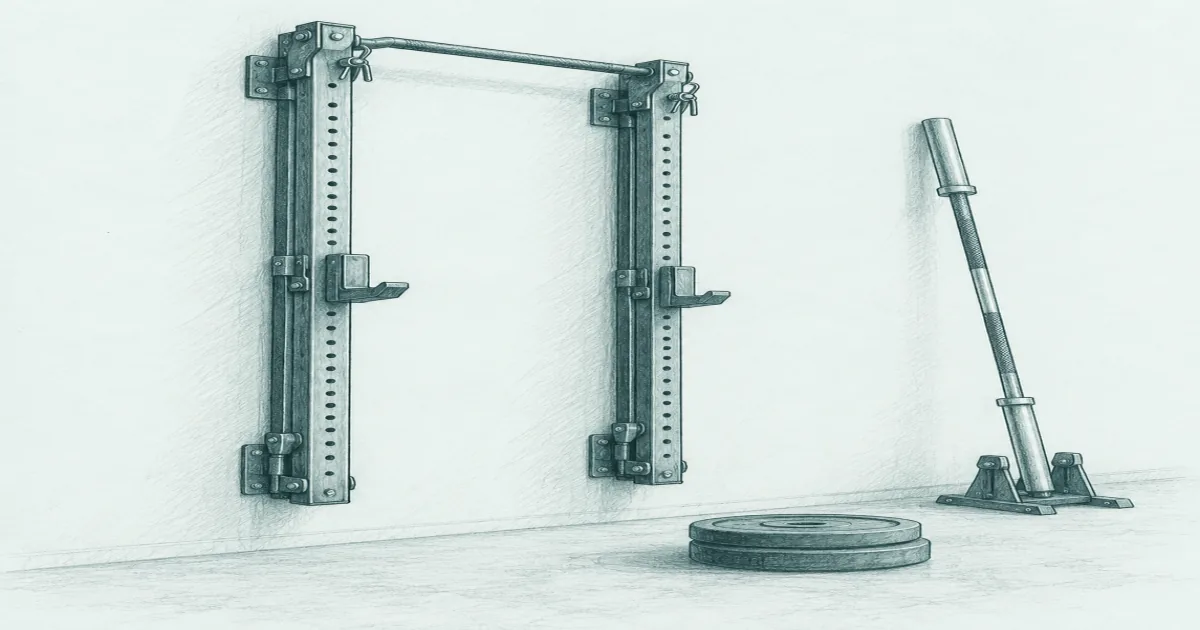
Best Folding Squat Rack (2026): Two Wall Racks That Fold Flat
Racks and benches
The best folding squat rack for most home gyms is the Mikolo 2x2 wall rack, because it folds to about 5 inches off the wall, takes 1,000 lb, and costs around $300. Here are the two wall racks worth buying, and how to check your wall first.
Our picks
The best folding squat rack for most home gyms is the Mikolo 2x2, and the fold is the main reason to buy it. You get a real squat and bench station that disappears into the wall when the session ends, which is the whole point when a garage also stores a car.
It sits in our racks and benches guides, alongside the best squat rack for home gym if you can give up a permanent corner. This guide covers the two wall racks we would buy and the wall check that decides whether either one is safe in your room.
Why a folding rack beats a full cage in a shared room
A freestanding power rack owns its floor space every hour of the day. Even a compact cage needs a few feet of depth you cannot use for anything else. In a one-car garage or a basement that doubles as an office, that is the space you actually need back.
A folding rack flips the trade. The wall carries the load and the rack folds flat, so you get the floor for the 23 hours a day you are not lifting. Setup takes seconds to a minute, and the folded rack hangs at full height, so you only need clearance where it lives.
The catch is the install. You need a solid wall, the right anchors, and someone to help lift the uprights into place. A freestanding rack just needs floor space.
The two folding racks worth buying
Both picks mount to the wall, fold flat, and take a standard two-inch Olympic bar. They differ in what else they bring.
Which folding rack gives back the most floor?
The GOIMU gives back more. It opens to about 12.3 square feet and folds to about 4.3, so it returns roughly 8 square feet, about two thirds of the space it takes. The Mikolo folds to a slim 5 inch profile instead.
What does each rack cost per pound of capacity?
The GOIMU costs less per pound of rating. Its $369.99 over a 2,000 lb rating works out to about 18.5 cents a pound, while the Mikolo's $299.99 over 1,000 lb is about 30 cents. So the $70 upgrade cuts your cost per pound by roughly 38% and adds cables.
Mikolo 2x2 Folding Rack: best for most home gyms
The Mikolo is the pick that gets the basics right. Two-by-two, 13-gauge steel and a 1,000 lb rating cover most home lifters. The pull-up bar, J-cups, and landmine come in the box, so there is no attachment shopping before your first session.
Why it is the top pick:
- It folds to a slim wall profile, so the room goes back to normal between sessions.
- UHMW-lined sandwich J-cups protect the bar and stop the uprights chipping.
- The included landmine also holds a bar upright when the rack is folded.
- Laser-cut numbers make it easy to match attachment heights side to side.
The trade is the install. Hanging the uprights is a two-person job, and you must hit solid studs or concrete. Once it is up, the fold is quick.
GOIMU WM3-V4: best folding rack with cables
The GOIMU is the pick when you want a rack and a cable machine but only have one wall. Five modes cover folded, semi-open, half rack, functional trainer, and cable crossover. The dual independent pulleys mean two people can train at once, or you can run supersets without re-rigging.
Why it is the best rack-and-cable combo:
- Independent 1:1 pulleys give each side true weight for rows and pulldowns.
- Five modes switch with quick pins in about a minute.
- It folds to about 4.3 square feet, so a shared room gets its floor back.
- The open modes leave room for cable flys, triceps work, and rows.
The trade is the install and the footprint when open. It needs concrete or solid wood studs, ships in two boxes, and takes more wall width than the Mikolo. The payoff is a rack plus a cable station in one spot.
How to check your wall before you buy
The wall is the real purchase decision. Run this check before you order either rack.
- Find the studs. Use a stud finder and mark centers. Mounting into drywall alone is a hard no at these loads.
- Pick the right anchor. Lag bolts into solid wood studs, or wedge anchors into concrete or block. Match the anchor to the material.
- Add a stringer if needed. On a stud wall behind drywall, a board bolted across two or more studs spreads the load and gives you a flat mounting surface.
- Check the ceiling. Both racks stand about 85 to 86 inches. Leave room above for pull-ups and for the folded uprights.
- Plan the bar path. Measure the bar's length plus a plate on each side. You need clear space left and right, not just in front.
- Test the fold once. Fold and unfold with an empty rack before you load it, so you learn the pins and the clearances.
Can you mount one on a metal-stud wall?
No. A metal-stud partition has no safe anchor at these loads, and neither rack ships hardware for it. Mount into solid wood studs, concrete, or block, and add a stringer board on a drywall-over-wood wall.
If your wall fails the check, a freestanding rack is the honest answer. See our squat rack guide for that path.
What to hang on a folding rack
A folding rack is a frame, and the attachments do the rest of the work.
- A pull-up bar is included on both picks and covers pull-ups, chin-ups, and hanging knee raises.
- A landmine turns the rack into a press and row station and holds your bar when it is folded.
- Safety arms or catches let you bench and squat near failure without a spotter.
- A dip attachment pairs well if you do not have a free-standing dip station.
- J-cups with UHMW liners protect a good bar's knurling, which matters once you own a decent barbell.
Add attachments over time. Start with what ships in the box, then buy the one that unblocks a movement you actually program.
Who should skip a folding rack
A folding rack is not for every room. Skip it if any of these sound like you.
- You have a permanent gym corner. A freestanding rack costs less and skips the wall work.
- Your wall is drywall over metal studs or a rented partition. There is no safe anchor, so do not force it.
- You want to load very heavy with thick bumpers. A full cage or a heavier rack is the sturdier base.
- You cannot drill into the wall at all. Then a freestanding rack or a doorway pull-up bar is your lane.
For everyone else, a folding rack is the way to keep a real squat station in a room that has another job.
Bottom line
For most home gyms, buy the Mikolo 2x2 Folding Wall Mounted Squat Rack. It folds to about 5 inches, carries 1,000 lb, and ships with the pull-up bar, J-cups, and landmine for around $300. If you want cable work from the same wall unit, buy the GOIMU WM3-V4 and use its five modes. Check your studs and your ceiling first, because the wall decides whether either rack belongs in your room.
Frequently Asked Questions
Are folding squat racks worth it?
They are worth it when floor space is the thing you cannot spare. A folding rack gives you a full squat and bench station, then clears the floor in seconds so the room goes back to being a garage, a basement, or a spare bay. If you have a permanent corner to give up, a freestanding rack is cheaper and simpler.
What is the best foldable squat rack?
For most home gyms, the Mikolo 2x2 folding rack is the best buy. It folds to roughly 5 inches off the wall, carries 1,000 lb, and comes with a pull-up bar, J-cups, and a landmine. If you also want cable work, the GOIMU WM3-V4 adds a dual pulley system to the same folding idea.
Are foldable squat racks safe?
They are as safe as the wall behind them and the install job. The rack itself is rated by the maker, so the weak link is usually the mounting. Bolt into solid wood studs or concrete, use a stringer board if the wall is drywall over studs, and re-check the bolts after the first few heavy sessions.
Which folding rack is better, the Rogue or the PRx Profile Pro?
Both are well-regarded American-made racks, and both cost more than the picks here. The Rogue folder is known for heavy steel and a stiff feel, while the PRx folds with a swing-out design that suits a low ceiling. If your budget is under $400, the Mikolo gives you most of the function for a third of the price.
How much space does a folding squat rack save?
More than the rack footprint number suggests. An open rack holds a chunk of the room all the time. A folding rack holds that space only during a session. The Mikolo folds to about 5 inches deep, and the GOIMU collapses to roughly 4.3 square feet of floor space.
Can a folding squat rack be mounted in a garage?
Yes, a garage is the most common home for one. Concrete block and poured walls are ideal because the anchors bite into solid material. If you mount to a wood-stud wall, drive the bolts into the studs or add a stringer board across them, never into drywall alone.
Do folding squat racks need to be bolted to the floor?
No, the wall carries the load. That is the main reason people pick one over a freestanding cage. The wall takes the tipping force, so the floor stays clear and you skip drilling into a slab or a rented floor.
What ceiling height do I need for a folding rack?
Measure before you buy. The Mikolo stands about 86 inches tall and the GOIMU about 85 inches, so you want a ceiling in the low 90s or higher if you plan to do full pull-ups. A folded rack still hangs on the wall at full height, so low pipes and joists matter even when it is stowed.