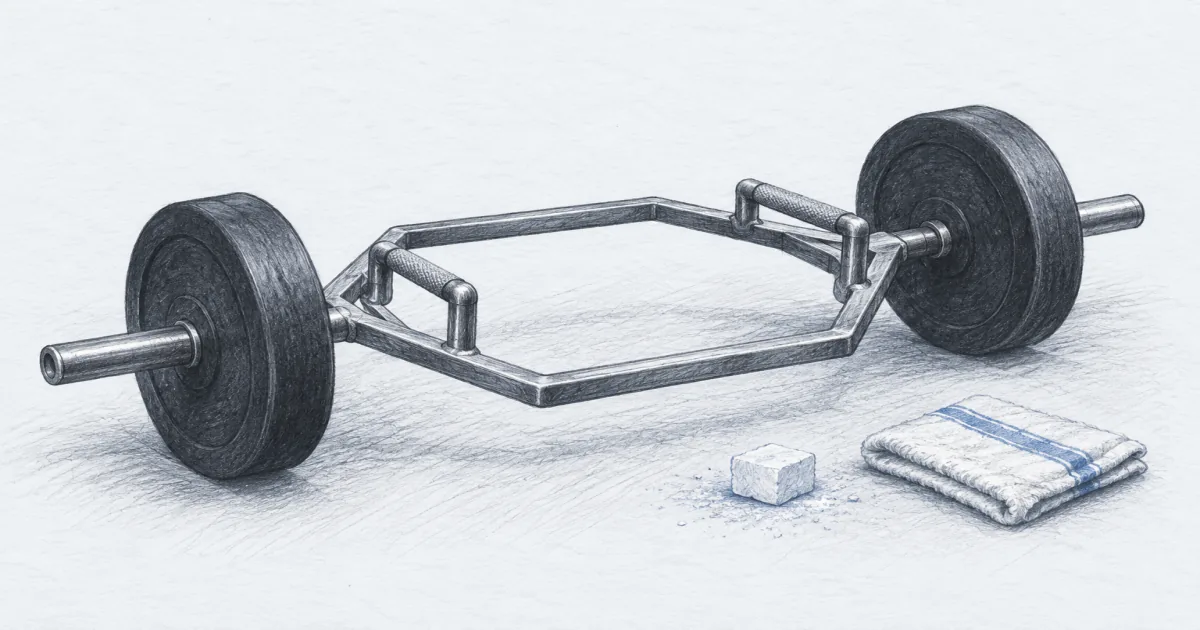
Best Trap Bar for Home Gym (2026): 3 Hex Bars for Pulls and Carries
Barbells and weights
The best trap bar for most home gyms is the CAP Olympic Trap & Shrug Bar, a 500 lb hex bar for around $80 with raised neutral handles. Here are the three bars worth buying, and who each one fits.
Our picks
The best trap bar for most home gyms is the CAP Olympic Trap & Shrug Bar, and it is the strongest pick on price and shape. A trap bar, also called a hex bar, puts the load around your body instead of in front of it. That one change keeps your torso more upright and takes pressure off your lower back on every pull from the floor.
It sits in our barbells and weights guides, and it pairs with a home gym barbell and a set of bumper plates. This guide covers the three bars we would buy and explains which frame suits your training.
What a trap bar changes about your training
A straight bar puts the weight in front of you. You have to lean over it, and your lower back does the work of holding that position while your legs drive. A trap bar puts the weight in line with your hips, so you can stand more upright and let the legs and hips take more of the load.
The neutral handles matter too. Your palms face each other instead of forward, which is a stronger, more natural grip for most people. That is why a trap bar deadlift often feels easier to learn than a conventional one.
What you give up is the specificity of a straight-bar pull. If you compete in powerlifting, the straight bar is the one you are tested on. If you train for general strength, health, or sport, the trap bar covers the same ground with less wear on the back.
The three trap bars worth buying
Each pick below is the one we would buy in that lane. All three use two-inch sleeves, so they fit standard Olympic plates.
Which trap bar is easiest to load?
Both the CAP and the Bells of Steel hold the bar level while you add plates. The CAP does it with bolt-on feet and no setup. The Bells of Steel goes further with a built-in jack that tips the plates clear of the floor.
CAP Olympic Trap & Shrug Bar: best overall
The CAP bar is the value pick that most home gyms should start with. It has raised neutral handles, a 500 lb capacity, and a price near $80, which leaves real budget for plates. For deadlifts, shrugs, and loaded carries, it does the job.
Why it is the top pick:
- The raised grips shorten the range and let you keep an upright torso on pulls.
- The built-in feet keep the bar level while you slide plates onto one side.
- Neutral handles are easier on the wrists and shoulders than a straight bar.
- Two-inch sleeves take standard Olympic plates you may already own.
The trade is finish quality. The welds are utilitarian and the coating scuffs with use, so it will not look new after a year of floor work. It will still pull straight.
Bells of Steel Open Trap Bar: best for carries and single-leg work
The open front is the whole point of this bar. You step in and out freely, which unlocks walking lunges, split squats, and farmer carries that a closed frame blocks. It is 47 lb, rated to 700 lb, and the rotating sleeves make accessory work feel smooth.
Why it is the best open bar:
- The built-in jack lets you load and unload without lifting the bar off the floor.
- Rotating sleeves cut the wrist torque a fixed-sleeve trap bar passes on.
- The open frame adds lunges, split squats, and carries to a single bar.
- At 59 inches long, it stays compact for a garage footprint.
The limit is sleeve length. They are shorter than a full barbell, so a stack of thick bumper plates fills them quickly. Thin iron or calibrated plates get you closer to the 700 lb rating.
PONE FIRST Hex Trap Bar: best budget
The PONE FIRST bar is the cheapest sensible way into trap-bar training. It is light, compact at 48.6 inches, and raised grips make the first pull easier to learn. For a beginner or a lifter who only pulls for general strength, it covers the job.
Why it is the best budget pick:
- At 14.5 lb, it stores on a hook or behind a rack with almost no footprint.
- Raised handles shorten the pull and suit newer lifters.
- The 48.6 inch frame fits rooms where a full-length bar would not.
- Snap springs are included, so there is nothing else to buy first.
The limit is the rating. At 400 lb, with 10 inch sleeves, it stops well short of what a serious puller needs. Buy it to learn the movement or to add pulls to a light program, not to chase a heavy single.
Open vs closed vs budget: which frame to buy
If you pull once a week and want the best value, buy the CAP. If you want one bar to cover pulls, carries, and single-leg work, buy the Bells of Steel. If space and price are the deciding votes, buy the PONE FIRST.
How to pick a trap bar weight and handle height
Two numbers decide how a trap bar feels: the bar weight and the handle height.
- Bar weight adds to the load. A 47 lb bar plus 90 lb of plates is 137 lb on the floor. The light economy bars keep that math friendlier for beginners.
- Raised handles shorten the pull. They put you in a stronger position and reduce the range, which is why they suit taller lifters and anyone working around a cranky back.
- Low handles match a straight-bar pull. Flip a dual-handle bar when you want the full range and more leg drive.
- Sleeve length sets your ceiling. Short sleeves fill up fast with thick bumper plates. If you load heavy or use bumpers, favor a bar with longer sleeves.
- Length sets your storage. A 48 to 59 inch bar hangs or tucks away easily. A 90 inch trap bar eats a wall.
What does a working set actually weigh?
The bar counts toward the load. Add the bare bar to your plates before you decide a rating is enough.
How many plates fit on the sleeve?
Sleeve length caps a heavy pull before the rating does. The CAP and the PONE FIRST both use short sleeves, and the Bells of Steel sleeves are shorter than a full barbell, so thick bumpers crowd the collar first.
If you are unsure, buy the bar and start with the raised handles. Move to the low handles once the movement feels automatic.
Who should skip a trap bar
A trap bar is not the right first purchase for everyone. Skip it if any of these sound like you.
- You only squat and bench. A squat rack and a bench cover those, and a straight bar does the pressing.
- You compete in powerlifting. The straight bar is the tested lift, so train it.
- You already own a straight bar and pull pain-free. A trap bar is a nice second bar, not a required one.
- You have no plates yet. Buy the bumper plates or an iron set first, because the bar is useless on its own.
If you want variety without a second bar, the trap bar is the one that adds the most for the least money. For everything else, our barbells and weights guides cover the straight-bar path.
Bottom line
For most home gyms, buy the CAP Olympic Trap & Shrug Bar. It has the raised grips, the 500 lb capacity, and the price to leave room for plates. If you want carries, lunges, and a built-in jack, step up to the Bells of Steel Open Trap Bar. If price and storage decide it, the PONE FIRST Hex Trap Bar gets you pulling for about $56. Whichever you choose, start on the raised handles and learn the hinge before you chase weight.
Frequently Asked Questions
What is the best trap bar for a home gym?
For most home gyms, the CAP Olympic Trap & Shrug Bar is the best buy. It has raised neutral handles, a 500 lb capacity, and a price near $80, so you can spend the rest of the budget on plates. If you want to lunge, split squat, and carry with the same bar, the Bells of Steel Open Trap Bar is worth the upgrade.
What are the best trap bar options?
The three shapes that matter are the closed hex bar for pulls and shrugs, the open trap bar for carries and single-leg work, and the light economy bar for a first setup. CAP covers the closed bar, Bells of Steel covers the open bar, and the PONE FIRST bar covers the budget lane.
Is a trap bar easier or harder than a straight bar?
Most people find a trap bar deadlift easier to learn. The load sits in line with your body instead of in front of it, and the neutral handles cut the strain on your lower back. It is not a shortcut, though. You still hinge, brace, and drive the floor, and an open bar adds movements a straight bar cannot do.
What's a good trap bar weight?
Match the bar to your current pull, not to a number you hope to hit. A 45 lb bar with a 500 lb or higher rating covers most home lifters for years. If you are buying a light economy bar, treat the rating as a ceiling, because thin frames flex more as you add plates.
What is the best open trap bar for a home gym?
The Bells of Steel Open Trap Bar is our pick because of the built-in deadlift jack and the rotating sleeves. The jack means you load without lifting the bar, and the spinning sleeves feel smoother on rows and carries. It costs more than a closed bar, so buy it only if you plan to use the extra movements.
Do trap bars fit standard weight plates?
Yes, a trap bar with two-inch sleeves fits standard Olympic plates, including iron, bumper, and change plates. If you already own a bumper plate set or an Olympic barbell, those plates slide straight onto a trap bar.
Can you deadlift with a trap bar?
Yes, and for many people it is the most comfortable deadlift variation. Standing inside the frame keeps the weight centered, which lets you keep a more upright torso. You can pull from the raised handles to shorten the range, or flip to the low handles when you want the full pull.
Is a trap bar worth it?
It is worth it if you pull from the floor, shrug, or carry, and you want a break from the straight bar. It is not worth it if you only squat and bench, because a rack and a bench cover those. One trap bar replaces a straight bar for pulls and adds farmer carries and lunges a barbell cannot match.