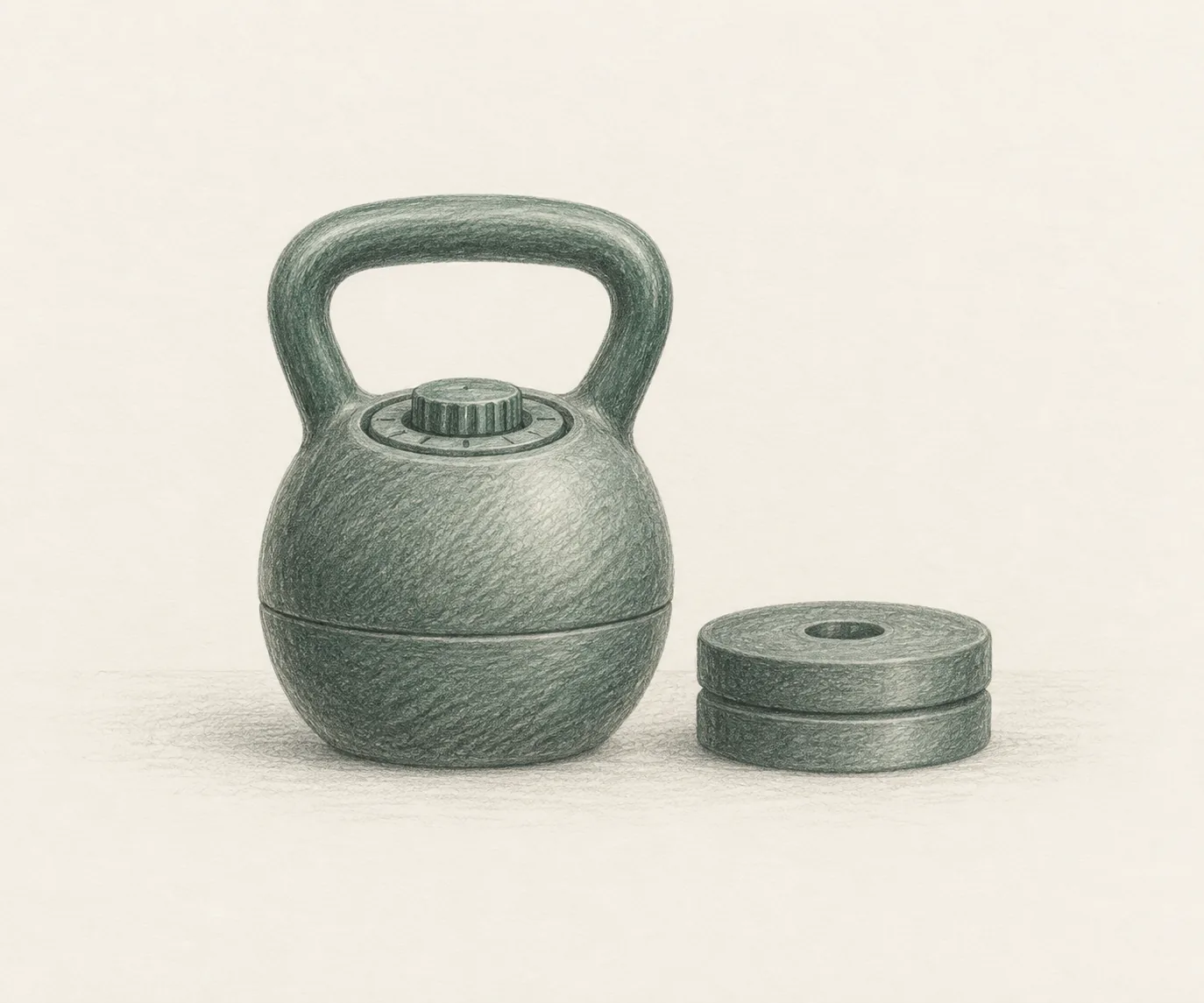
Best Adjustable Kettlebell (2026): One Bell, Six Weights
Barbells and weights
The best adjustable kettlebell for most home gyms is the BowFlex SelectTech 840, because the base dial moves you from 8 to 40 lb in seconds, so a swing and a press use the same bell. Here are the three worth buying.
Our picks
The best adjustable kettlebell for most home gyms is the BowFlex SelectTech 840, and the dial is the whole reason. It moves from a light warm-up to a 40 lb swing without a second bell taking up floor space.
It belongs in our barbells and weights guides, beside the best kettlebell set if you would rather own a rack of fixed bells. If you are buying your first single bell for technique, our kettlebell for beginners guide covers that lane. This guide is about the one bell that changes weight.
Why one adjustable bell beats a rack of kettlebells
Kettlebell training wants different loads for different moves. You swing heavier than you press, and you warm up lighter than you work. A fixed bell is either wrong for half your session or you own a rack of them.
An adjustable bell solves both problems at once. It replaces four to six fixed bells with one unit that lives in a small cradle or on the floor. You change weight at the bell rather than walking to a rack, which keeps a circuit moving.
The honest cost is feel. A one-piece cast bell has a seamless handle and a center of gravity that never moves. An adjustable bell carries its plates inside a housing, so the grip and balance are a little less unified. For slow work like presses, goblet squats, and carries, most people stop noticing within a few sessions.
The three adjustable kettlebells worth buying
What does each bell cost per pound of range?
The Yes4All costs the least per pound of range. The BowFlex and Rep cost more for a dial, cast iron, or both. Divide today's price by the pounds of range the bell covers, and remember the Rep's 40 lb bell starts at 20 lb, so its range is half the BowFlex's.
Which bell actually covers a warm-up?
Only the BowFlex and the Yes4All go below 10 lb, and that is the detail that decides a first bell. Plenty of first Turkish get-ups are practiced with a shoe or an 8 lb bell, so a bell that begins at 20 lb leaves those drills to something else.
The Rep's 20 lb floor is not a defect, it is a design choice: the 20-40 lb bell is built for someone who already presses and swings a real load and wants the finest step in the middle of the range. Buy it as a second bell, not a first one.
Which bell has the smallest jump between settings?
The Rep has the tightest step at 5 lb, the Yes4All averages 5.4 lb, and the BowFlex averages 6.4 lb. Step size matters most on presses, where a 10 lb jump can stall a set that a 5 lb jump would finish.
Look at where the big jumps land, not just the average. The BowFlex jumps 10 lb between 25 and 35, which is the widest gap on any of the three and the one place its dial feels coarse. The Rep's 5 lb steps are even all the way up, which is why it is the pick for press progression.
BowFlex SelectTech 840: the best all-rounder
The BowFlex SelectTech 840 is the default adjustable bell. Six settings from 8 to 40 lb cover a wide range of training, and the dial is fast enough for circuits. It stores in its own cradle, so the footprint is one small square of floor.
Why it is the top pick:
- Six weights from 8 to 40 lb on one bell.
- A dial that clicks into each setting in seconds.
- A cradle that keeps storage to one small square.
- A handle window that fits two hands for swings.
The trade is durability under abuse. The shell is plastic, so it is a bell you set down, not one you bail onto concrete. Used that way, it holds up for years.
Rep Fitness 40 lb: the best for strength work
The Rep Fitness 40 lb is the pick for lifters who care about feel. It uses cast-iron plates with individual fasteners, a matte powder coat, and a rubber base, and the competition shape keeps the movement consistent across weights. REP sells three sizes, and the Amazon listing is the 20 to 40 lb bell, so check which one you are buying before the price comparison means anything.
Why it is the best for strength:
- Cast-iron shell and plates that feel like a fixed bell.
- A push-and-twist dial with very little rattle in motion.
- A competition shape for the rack and overhead positions.
- A rubber base that protects the floor.
The trade is the dial housing. On get-ups and long rack holds, a few lifters find the plastic edge digs in. If that is a concern, a fixed bell is the better tool for those moves.
Yes4All: the best budget bell
The Yes4All is the cheapest way into kettlebell training with real iron. It uses a cast-iron handle and plates, a screw-down cap, and a flat base, and its seven settings run from 7.8 lb to 40 lb, which covers the range most beginners need.
Why it is the best budget pick:
- A cast-iron handle with the grip of a fixed bell.
- A secure lock that keeps plates from shifting.
- A round rubber base for upright storage.
- A price that starts a home setup for under $100.
The trade is speed. Changing weight means unscrewing the cap and restacking plates, which is fine between sets and slower in a circuit. It is also worth buying a fixed bell later if you fall in love with fast, ballistic work.
Dial vs plate-loaded: which adjustment suits you
The adjustment system decides how the bell feels in daily use.
- Choose a dial if you train circuits, supersets, or warm up with lighter sets of the same movement. Changing weight takes seconds, so you keep moving.
- Choose plate-loaded if you do straight sets and want the most iron for the money. The slower change is a small pause, not a problem.
- Skip both if you plan to bail the bell onto a floor. Buy a fixed cast bell for that.
There is no wrong answer here. The right system is the one that matches how often your weight needs to change.
Handle shape and the swing test
The handle matters more than any other part of an adjustable bell, because you hold a kettlebell far more than you set it down.
- Window width. You want room for two hands on swings and goblet squats.
- Thickness. A very thin handle can dig into the palm on high-rep work.
- Finish. Cast iron and powder coat grip well when hands get sweaty.
- Housing clearance. On dial bells, check that your forearm clears the mechanism in the rack position.
If you can, put hands on a bell before you buy. A handle that fits your hand makes more difference than an extra resistance increment.
Do adjustable kettlebells rattle during swings?
The better ones barely rattle. The Rep Fitness bell gives each plate its own fastener, so it stays quiet in motion, while the BowFlex can show a slight wobble in the stem and cheap plate-loaded bells can clank. A small rattle is normal; a loud one means the plates were not fully seated, so reseat and retighten before your next set.
Rattle usually comes from plates that were not seated, not from the bell itself. On a dial bell, the plates only lock when the handle is fully pressed into the base and the dial clicks into a detent. If you lift the bell off the base before you hear that click, the plates can sit loose and knock on the first swing. Set it back down, turn the dial until it clicks, and the noise goes away.
What weight range do you actually need?
Aim for 8 to 40 lb if you are new to kettlebells, because that spread covers a light warm-up, a moderate press, and a heavier two-hand swing. Stronger lifters who clean and swing heavy will want a bell that reaches 24 kg, so buy the range above your current strength, not at it.
The reason to buy above your current press is arithmetic. A kettlebell is a long-term purchase, and 40 lb is the light end of a two-hand swing for a trained lifter. If you buy a bell that tops out at your current press, you will outgrow it in a few months. Look at the step size too: the BowFlex averages 6.4 lb jumps, and its widest gap is 10 lb between 25 and 35, which is the one place a pressing program will feel coarse.
How do you keep a dial bell from marking the floor?
Keep a mat or a folded towel under the base. The rubber feet on the BowFlex 840 base can leave faint black smudges on a bare hard floor if you set the bell down without a cover, and a cheap mat also catches the plate you rest between sets. The fix costs almost nothing and keeps a garage or a wood floor clean.
What should you check before the dial will turn?
Check that the light plate is seated in the base. On the BowFlex 840, the dial will not rotate if the 5 lb plate is not sitting in the base, which is the most common "stuck dial" complaint. Set the bell fully into the base, confirm the plate is in place, then turn the dial until you feel the click. If it still will not move, remove the plates, clear any grit from the base, and try again.
Who should stick with a fixed kettlebell
An adjustable bell is not the right answer for every lifter.
- You train ballistic and drop the bell. Buy a fixed cast bell, because internal hardware does not survive drops.
- You want maximum weight for the money. A barbell and bumper plates carry more load per dollar.
- You already own several bells. Keep them and add an adjustable for the gaps.
- You only ever use one weight. A single fixed bell is simpler and cheaper.
For everyone else, one adjustable bell is the fastest way to make kettlebell training fit a small space.
Bottom line
For most home gyms, buy the BowFlex SelectTech 840. One dial covers 8 to 40 lb, so a warm-up, a press, and a swing all use the same bell, and it stores in a small cradle.
If you want cast-iron feel for strength work, buy the Rep Fitness 40 lb. If you want the most iron for the least money and do not mind slower changes, buy the Yes4All. Pair your bell with a floor mat if you train on concrete, and add a fixed bell later only if you start dropping heavy reps.
Frequently Asked Questions
What is the best adjustable kettlebell for a home gym?
For most home gyms, the BowFlex SelectTech 840 is the best buy. Its base dial moves from 8 to 40 lb across six settings, so one bell covers warm-ups, presses, swings, and squats, and changes take a couple of seconds. If you want a cast-iron bell that feels closer to competition iron, the Rep Fitness 40 lb is the stronger choice, and the Yes4All is the budget starter.
Are adjustable kettlebells as good as fixed kettlebells?
They are close for slow, controlled work and clearly more space-efficient. A fixed cast bell has a seamless handle and a settled center of gravity, which feels better on fast swings. An adjustable bell trades some of that feel for the ability to change weight without buying five more bells. For home use, most people prefer the space savings.
Can you drop an adjustable kettlebell?
No, and this is the rule that matters most. Dial and plate systems carry internal hardware that a one-piece cast bell does not, so a drop onto a hard floor can crack a plate or jam the mechanism. Set it down under control after every set. If your training regularly ends with a bail to the floor, buy a fixed bell instead.
What weight range do I need?
Aim for 8 to 40 lb if you are new to kettlebells. That spread covers a light warm-up, a moderate press, and a heavier two-hand swing. Stronger lifters who swing and clean heavy will want a bell that reaches 24 kg or more. Buy the range above your current strength, not at it, because a kettlebell is a long-term purchase.
How long does it take to change weights?
A dial system takes a couple of seconds. You set the bell back in its cradle, turn the dial to the next weight, and lift. A plate-loaded bell takes longer, because you unscrew a cap, add or remove plates, and screw it back down. For circuit training, the dial is the faster system. For straight sets, the plate change is a minor pause.
Is an adjustable kettlebell good for beginners?
It is one of the best first purchases for a home gym, because it grows with you. A beginner can start light and add weight as the press or swing gets easier, without buying a second or third bell. Start with the technique first, then move up in small steps. A single adjustable bell and one floor mat can cover months of training.
Do adjustable kettlebells rattle during swings?
The better ones barely do. The Rep Fitness bell gives each plate its own fastener, so it stays quiet in motion. The BowFlex can show a slight wobble in the stem, and cheaper plate-loaded bells can clank. A small rattle is normal, but a loud one usually means the plates were not fully seated, so reseat and retighten before your next set.
Dial or plate-loaded: which should I buy?
Buy a dial if you change weight often, train circuits, or want the fastest setup. Buy a plate-loaded bell if you want the most iron for the money and do not mind a slower change. The BowFlex and Rep Fitness use dials, and the Yes4All is plate-loaded. Both systems work, so pick based on how often the weight needs to change.