How Many Bumper Plates a Home Gym Needs (2026 Sizing Guide)
Barbells and weights
A bumper plate set for a home gym is a sizing decision, not a brand one. Here is how many plates to buy, how much sleeve they use, and the CAP sets that fit a garage.
Our picks
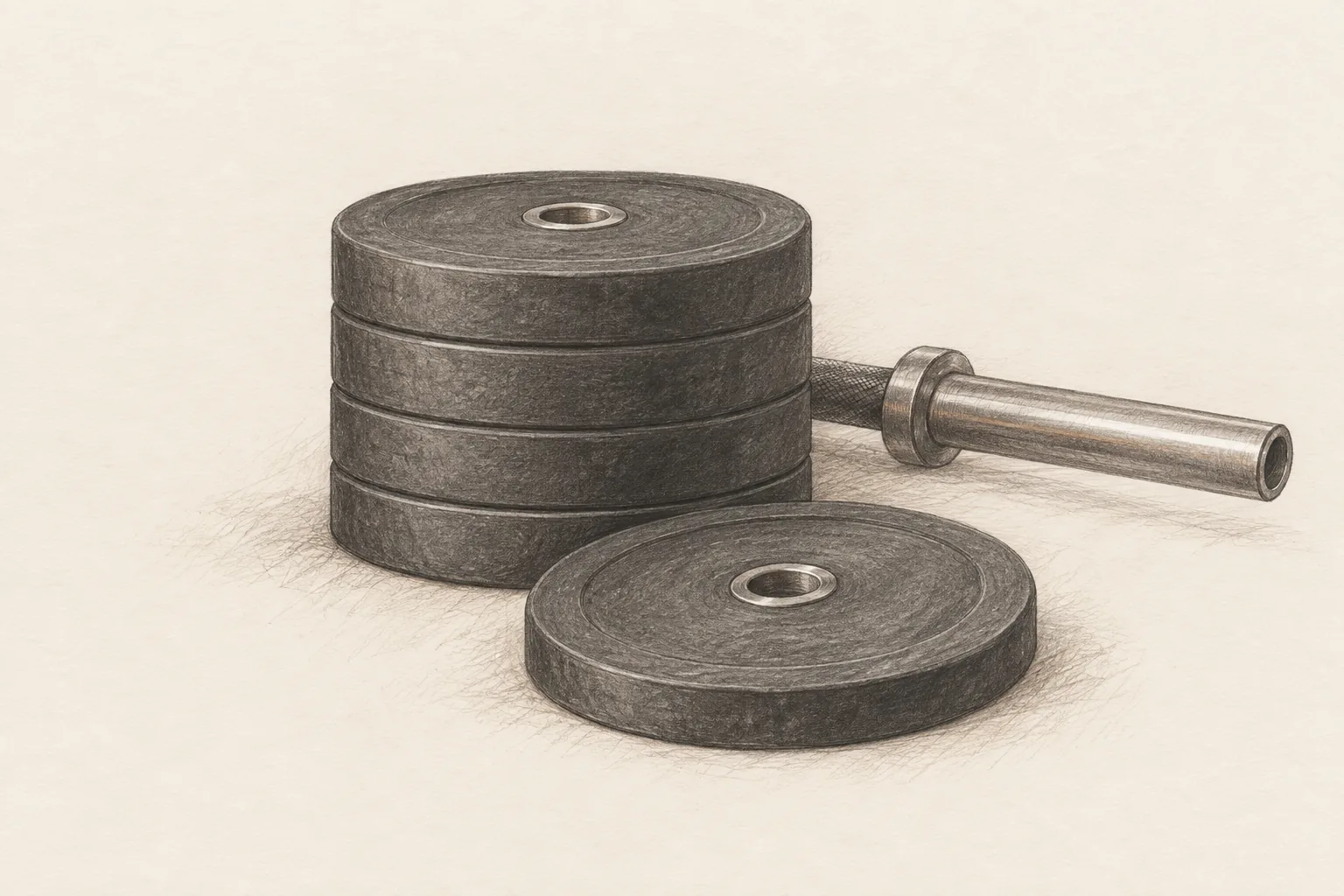
A bumper plate is the plate you can drop. It is a rubber disc around a steel hub, and in a garage or basement it saves both the floor and the bar. The set that sizes right for most garages is the CAP 260 lb Economy, and the question is how many of them your space, your sleeve, and your training actually need, because a 260 lb box takes up a corner whether or not you use every size in it.
This guide sizes a bumper set for one home gym. It pairs with our home gym barbell guide, and it is the home-gym companion to our broader bumper plate guide, which covers what each plate is made of and how the different CAP lines compare. Here we stick to the fit: how many plates, how much room, and where they live.
How many bumper plates does a home gym need?
For most home gyms, a 260 lb set covers a pair of every size from 10 to 45 lb, which is warm-ups through a 305 lb pull with a 45 lb bar. Add a pair of 45s once your working sets climb past that.
The table below is the whole decision for most people. Match the set to the heaviest pull you actually train, then leave one pair of margin.
Which set fits a beginner, and which fits a four-plate pull?
A beginner pressing and squatting under 225 lb is covered by the 100 lb set plus a starter bar. A 315 lb pull needs three 45s a side, and neither set holds that many: the 260 lb set tops out at 305 lb and the 160 lb set at 205 lb, so plan on an extra pair of 45s either way.
The 260 lb set is also the one that stops you shopping mid-program. It includes the 35s that a 160 lb set skips, so a 275 lb work set stacks cleanly instead of forcing four plates a side early. Buy the 260 if you plan to keep pulling for years; buy the 160 and a pair of 45s if you want the same top end with less rubber on the shelf.
How many bumper plates fit on a barbell?
A standard Olympic sleeve is about 16.5 inches long. At 2.68 inches thick, two CAP 45 lb economy bumpers per side use about 5.4 inches, so plan on four plates per side before the collar has no room left.
Why do bumpers run out of sleeve before iron does?
Rubber is far less dense than steel, so a 45 lb bumper has to be much thicker than a 45 lb iron plate to hit the same weight. The diameter stays fixed at 450 mm so every plate lands at the same height, which leaves thickness as the only place for the extra rubber to go.
That is the trade you accept for a plate you can drop. It also explains the practical ceiling. The same 90 lb that takes about 2.4 inches in iron takes about 5.4 inches in bumpers, so a strong lifter on a short-sleeved bar can run out of loadable length before running out of strength. If you pull near 500 lb, a few thin iron plates for the top of the stack buy back sleeve that a wall of economy bumpers spends.
The bumper sets worth buying
Each pick below is the set we would buy in that lane. All four use a 2 inch center hole, fit a standard Olympic bar, and share the same steel floating hub and medium-bounce rubber blend.
CAP 260 lb Economy Olympic Bumper Plate Set: best for most home gyms
The 260 lb set is the one to buy when you want the whole ladder in a single order. It gives you a pair of 10s, 15s, 25s, 35s, and 45s, and the rubber blend takes a dropped rep without launching the bar back at you.
Why it is the top pick:
- A pair of every size means you can warm up and work up without hunting for a plate.
- The uniform 450 mm diameter keeps the bar level, which matters most on pulls from the floor.
- One 45 a side plus the rest of the set reaches 305 lb, and a second pair of 45s takes it to 395 lb.
- The steel hub seats on a standard sleeve and stays snug under repeated drops.
Two things to know. The plates ship greasy and rubbery-smelling, which one wash and a few days of airing fixes. The 10s and 15s are thin, so keep them paired with a 25 or heavier on the bar.
CAP 160 lb Economy Olympic Bumper Plate Set: best mid-size
The 160 lb set is for the lifter who is past the first month and pulling toward 200 lb but does not want to pay for sizes that sit on the tree. Pairs of 10, 25, and 45 do the work, and one more pair of 45s takes you to 295 lb later.
Why it fits the mid-size lane:
- Pairs of 10, 25, and 45 put 205 lb on the bar without extra sizes.
- Same steel floating hub and medium-bounce rubber as the bigger CAP sets.
- Lighter box than a 260 lb set, which matters if your gym shares a room.
- Easy to extend with a single 45 as your numbers climb.
The trade is range, not quality. There are no 35s, so the jumps between 185 and 225 take more plates per side, and you cannot load as finely in the middle of the range. For most garage lifters that is a fair deal.
CAP 100 lb Economy Olympic Bumper Plate Set: best starter set
The 100 lb set is the low-commitment way into bumper plates. It includes pairs of 10, 15, and 25 lb with the same hub and rubber as the set twice its size. If you already own a bar and want to start deadlifting without dropping serious money, this is where to start.
Why it is the starter pick:
- Matched pairs of 25s, 15s, and 10s at the lowest entry price.
- The same steel hub and medium-bounce rubber as the 260 lb set.
- Easy to run alongside iron plates you already own.
- Light enough to move around while you build the habit.
The trade is the ceiling. It tops out at 25 lb per bumper, so most lifters add 45s within a few months. Treat it as a starter set and plan to add heavier plates later.
CAP 45 lb Economy Olympic Bumper Plate, Single: best add-on
Singles are how most home gyms actually grow. You add a pair of 45s when your deadlift climbs, then another pair when it climbs again. Buying one plate at a time keeps the spend tied to your progress instead of a big upfront set.
Why it is the add-on pick:
- You can match the plates you already own instead of buying a second full set.
- The raised edge gives you a grip for solo plate work.
- Same steel floating hub and rubber blend as the sets.
- Buying one at a time keeps the cost tied to your lifts.
The limit is the count. It is one plate, not a pair, so plan on two for balanced loading, and it is an economy plate built for home use rather than a commercial floor.
Where should bumper plates live in a small gym?
Store bumpers on a rack or a tree, not in a flat stack on concrete. A six-peg tree rated for 400 lb with 35 mm pegs holds a full 260 lb set, and keeping the plates vertical protects the thin 10s and 15s from warping.
A little planning saves a lot of shuffling. Bumpers are wide, so a 260 lb set takes real wall space.
- Floor space. Budget about 2 square feet per pair on a tree, plus a clear path to the bar. A tree in the corner beats a floor stack every time.
- Floor protection. Rubber protects the plates and the bar, but a 45 dropped hard still marks concrete. A stall mat or platform under the bar is worth the $100.
- Ceiling. A 45 lb bumper puts the bar at the same 450 mm start height as a competition plate, so a pull from the floor needs the same room you would give any loaded Olympic bar.
Do you need a bumper plate rack?
A rack is not required, but it is the cheapest upgrade after the plates. It keeps the set vertical, makes loading a pair faster, and stops the light plates from lying flat and warping. A basic six-peg tree is enough for one home set.
How do you break in a new bumper set?
Wash each plate with dish soap and warm water, dry it, then let the set air in the garage with a fan for a few days. The factory oil film and rubber smell fade in about a week, and the plates stop feeling slick.
The break-in is the one chore every new bumper set asks for. It takes an evening and it is worth doing before the plates go indoors.
- Wipe first. A degreaser or dish soap removes the oil film that ships on new rubber plates.
- Air them out. A fan in a ventilated garage speeds up the smell fade; indoors takes longer.
- Reseat the light plates. Keep 10s and 15s paired with a 25 or heavier so they do not flex under a lone load.
- Check the hub. A quick look at the steel insert before the first session catches a rare loose hub.
Why do new bumper plates smell, and how long does it last?
New rubber plates carry a smell and an oil film from manufacturing. Air them in a ventilated space for a few days and wash them with dish soap. Most owners report the smell gone within a week, and at the outside a month.
Who should skip bumper plates?
Skip bumpers if you only squat and press inside a rack, if you are loading for max weight and need the thinnest plate per pound, or if you are on a tight budget. Iron is cheaper, thinner, and lasts decades for controlled lifts.
Bumpers pay for themselves when the bar leaves your hands with speed. If it does not, put the money into a better bar or a bench instead.
- You never drop the bar. Rack squats and bench presses do not need rubber.
- You are loading for max weight. Iron is thinner, so you fit more per sleeve.
- You are on a tight budget. Iron costs less per pound and does not wear out.
- You need fractional plates. Small iron change plates are cheaper and easier to find.
If you split the difference, run bumpers for pulls and iron for everything else. Our trap bar guide and a weight bench round out the room, and both pair cleanly with a mixed plate stack.
Bottom line
For most home gyms, get the CAP 260 lb Economy Olympic Bumper Plate Weight Set. It covers every useful size in one order and drops quietly on a garage floor, and it is the set that stops you shopping mid-program. If you are already near a 200 lb pull and want to skip rare sizes, get the CAP 160 lb set.
If you are starting from zero on a budget, the CAP 100 lb set is the cheapest way in, and a CAP 45 lb single is how you grow it. Whichever you pick, wipe the plates down before the first session, keep the light ones paired, and store the set on a tree instead of the concrete.
Frequently Asked Questions
How many bumper plates do I need for a home gym?
Start with a set that covers a pair of every size up to 45 lb, which is 260 lb in the CAP line. That puts 305 lb on the bar with a 45 lb bar, which is enough for most beginner and intermediate lifters. If you pull past 305 lb, add a pair of 45s before anything else.
How many bumper plates fit on a barbell?
A standard Olympic sleeve is about 16.5 inches long. A CAP 45 lb economy bumper is 2.68 inches thick, so two per side use about 5.4 inches. Plan on four plates per side, roughly 360 lb plus the bar, before a thick economy set runs out of sleeve.
Are bumper plates worth it for a home gym?
Yes, if you drop the bar. Bumpers protect a concrete floor and the bar in a way iron cannot, and they are quieter on a set-down in a shared space. If you only squat and press inside a rack, iron is cheaper and thinner.
What are the downsides of bumper plates?
They cost more per pound than iron, they are thicker on the bar, and the light plates flex under a lone load. New rubber plates also carry a smell and an oil film that need a wipe-down. None of that affects training once the plates are on the bar.
What is the best brand of bumper plates?
CAP is the most reliable budget bumper brand on Amazon, with a deep catalog of sets and singles. Rogue, REP, and Vulcan make thinner, more accurate plates for more money. For most home gyms, CAP is the value pick.
Do bumper plates smell?
New rubber plates often smell for the first week or two and arrive with a light oil film. Open the boxes, let the plates air out with a fan for a few days, then wash each one with dish soap and water. The smell fades and the plates stop feeling slick.
Can I mix bumper plates with iron plates?
Yes, most home gyms do. Put the bumpers on the bar first and load iron outside them, so the rubber takes the floor contact and the iron adds weight without touching the ground. That protects the floor and lets you grow a set one pair at a time.
Do I need a rack for bumper plates?
A rack keeps the plates off the floor and makes loading faster, but it is not required. If you buy one, a six-peg weight tree rated for 400 lb with 35 mm pegs holds a full 260 lb set and keeps the plates off the concrete between sessions.